
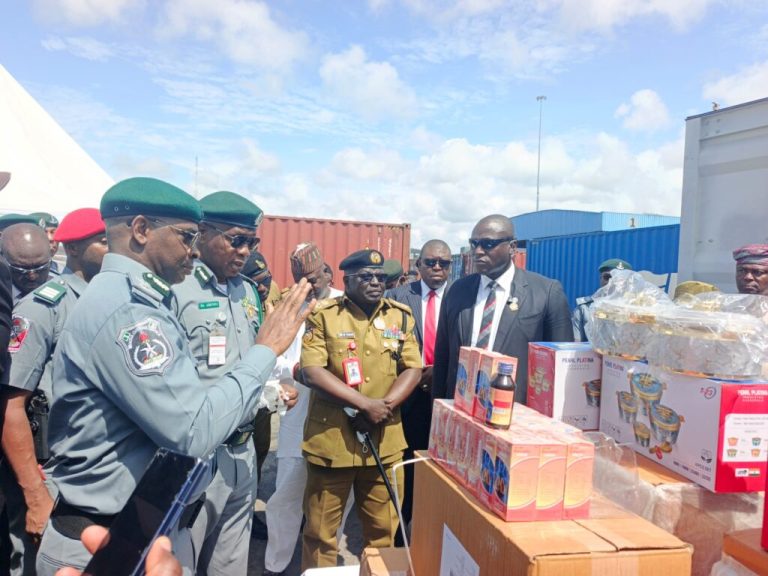
The Comptroller General of the Nigeria Customs Service, NCS, Adewale Bashir Adeniyi has reiterated that Customs would continue to resist all attempts to use the nation’s ports as channels for narcotics, controlled drugs, security-sensitive equipment and other prohibited or harmful goods trafficking.
Speaking at a press briefing on Thursday in Lagos, the Comptroller-General disclosed that three containers laden with 7,624kg of cannabis sativa, equivalent to more than 7.6 tonnes, and another containing 169,998 bottles of codeine syrup were intercepted at the Apapa Area Command, Lagos following sustained intelligence-led operations and enhanced cargo profiling.
According to him, the seizures, comprising narcotics, controlled pharmaceuticals, security-sensitive equipment and expired products, have a combined duty-paid value (DPV) of N43.59 billion.
Adeniyi revealed that the three cannabis-laden containers contained a total of 15,245 parcels weighing 7,624kg.
He explained that the seizures were made possible through intelligence sharing and operational collaboration between the Customs Service, the National Drug Law Enforcement Agency (NDLEA), NAFDAC and international security partners.
The Nigeria Customs he stated has strengthened its cargo profiling and risk-assessment systems, including the deployment of the B’Odogwu digital platform, to improve the identification of high-risk consignments.
The Customs boss also noted that the Service recently established an INTERPOL Data Centre at its headquarters in Abuja, providing officers with access to more than 152 international databases to support intelligence-led border control.
The cannabis consignments he added were concealed in containers carrying legitimate-looking cargo, including automobile spare parts, food products and vehicles.One of the containers, he said, contained 1,700 cartons of codeine syrup, amounting to 169,998 bottles, concealed beneath household items.
He also disclosed the interception of 108 high-definition dual-camera drones, stressing that while drones had legitimate applications, security-sensitive equipment required appropriate approvals, end-user certificates and other documentation before clearance.
Adeniyi while warning that the abuse of controlled substances, particularly codeine and cannabis, poses serious risks to young Nigerians and the wider society, said
“Our ports will not be a route through which capability reaches those who are working against the security of this country.”
Five other containers were found to be loaded with expired products, including tomato ketchup, antiseptic liquid, vaginal tablets and disposable nappies were also Intercepted alongside 1,282 bales of used clothing contained in three separate containers.
Adeniyi further maintained that the importation of expired products posed serious public-health risk, particularly to unsuspecting consumers assured legitimate traders that the Service remained committed to facilitating lawful commerce as well as intensifying scrutiny of consignments, transactions and operators presenting identifiable risks.
He advised importers uncertain about the classification, valuation or origin of their goods to utilise the Customs Advance Ruling mechanism before shipment, while encouraging compliant businesses to enrol in the Authorised Economic Operator (AEO) programme, which provides more predictable clearance and fewer interventions where risk assessments permit.
CG, Bashir Adeniyi commended officers of the Apapa Area Command and the Service’s partner agencies for their vigilance and cooperation.